
Burlington Previous Residents by Era
An address history is strongest when the source fits the year. Modern parcel systems can supply a current parcel number and owner label, but they do not explain each prior household. For earlier Burlington previous residents, the library's reverse directories and census holdings are often more direct. Deed and probate material then connect legal transfers to the same lot. The table separates sources by date and purpose so a gap in one record does not end the search.
| Source | Years or coverage | Where held | What it shows |
|---|---|---|---|
| Deeds and town-lot records | County series from 1837 to 1902; modern cutoff not published | Recorder, Iowa Land Records, State Historical Society | Grantors, grantees, legal descriptions, recorded transfers |
| Reverse directories | From 1889 | Burlington Public Library | A dated name or subscriber associated with an address |
| City and phone directories | 1856 business-only; later runs from 1859; phone books from 1934 | Library, FamilySearch, Library of Congress | Names, initials, occupations, addresses, or phone listings |
| Census schedules | Federal holdings 1840 to 1930; selected Iowa census years | Library and research databases | Households and relationships recorded for a census date |
| Maps and permits | Sanborn maps 1886 to 1931, additions through 1950; permit reports include 2021 to 2026 | Library and City of Burlington | Building form, use, address context, and dated property work |
Start with the newest dependable parcel reference, then move back. If the target year falls before the reverse directory run, a deed index, census, newspaper, probate file, or map may be the better first stop. An absent entry means only that the name was not found in that edition or holding.
Burlington Reverse Records Start Early
The Burlington Public Library tracing guide says reverse-by-address directories begin in 1889. That gives house historians a rare way to search the place first, even when no past resident name is known. Record the edition year, street spelling, house number, listed name, and any business or subscriber marker. A reverse entry is a dated association, not proof that every person in the household lived there for the whole year.
The library also lists 1856 as business-only, followed by 1859, 1862, 1866, and a long microfiche run from 1868 through 1995. Help-desk access covers 1996 to the present. These collections are described in depth on the Burlington city directory page; for previous residents, the key task is choosing editions just before and after a known move, sale, birth, or death.
The captured library page shows the local research route available when an edition or card file is not online.
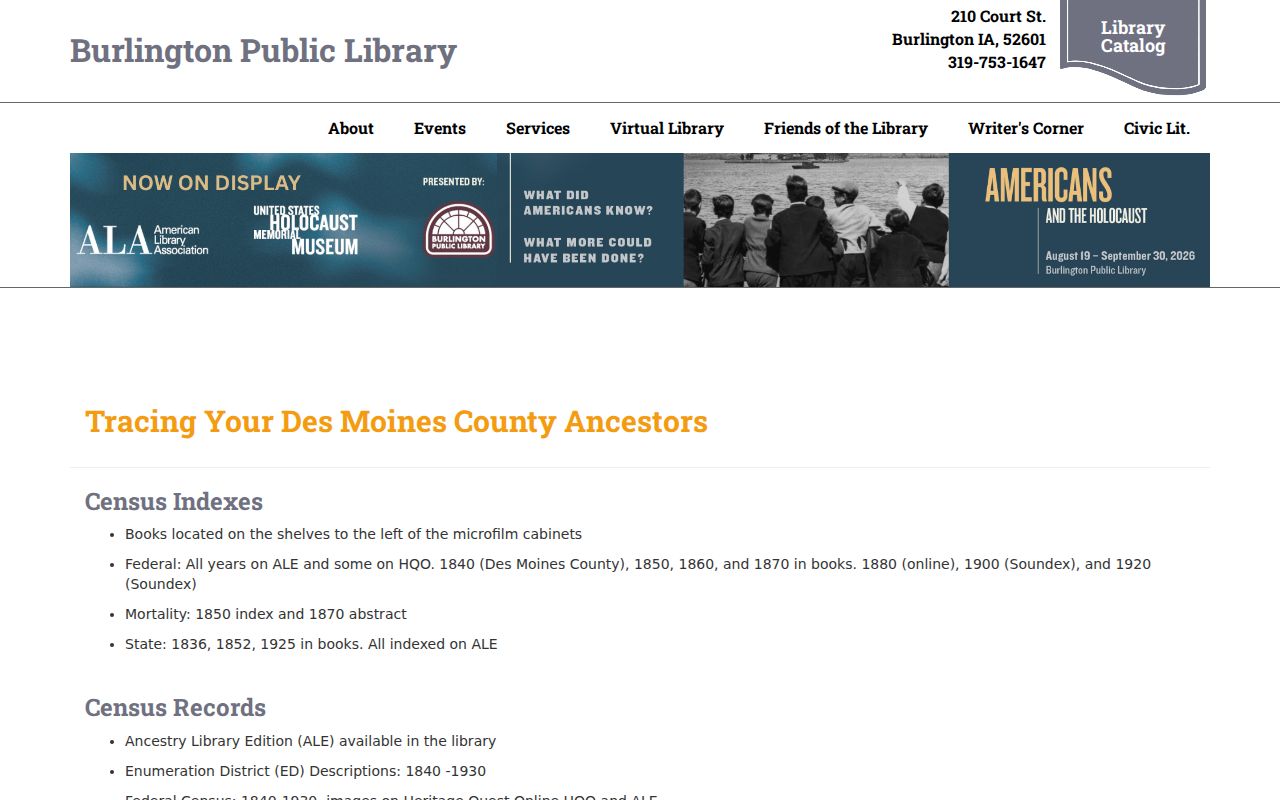
Its guidance anchors an address search in Burlington's actual directory years rather than a guessed national collection.
Burlington's 1938 Address Break
Street numbering changed in Burlington in 1938. That fact can make a sound search appear to fail. A house number printed in a 1930 directory should not be carried into a current parcel search without a bridge. Compare the old directory with a dated Sanborn sheet, plat, city record, or later directory that supports the link between the former and modern number.
This is one of Burlington's most useful house-history quirks. Reverse directories began decades before the change, so both old and new numbering systems may appear in the collection. Keep both numbers in the notes and cite the map or record used to crosswalk them. Street names, lot numbers, and legal descriptions can add more stable points when the number changed.
Address tip. Never replace a pre-1938 Burlington number in a citation; place the supported modern number beside it as a separate note.
Walk Burlington Deeds Backward
The Des Moines County deed chain supplies the ownership spine. First locate the parcel in the Assessor or GIS system and save its parcel number and legal description. Then search the current owner's acquisition instrument. In a deed, the grantor transfers an interest and the grantee receives it. The prior seller can then be searched as a grantee to locate the earlier purchase.
- Search the Assessor by house number and street name. Save the parcel number, deed-holder label, and legal description without treating the card as proof of occupancy.
- Use a free account at Iowa Land Records to find the deed by party, parcel clue, or instrument detail when available.
- Read the instrument number, date, grantor, grantee, and legal description. Confirm that the land, not merely a similar name, matches.
- Search the seller as an earlier grantee. Repeat the transfer link, noting mortgages, releases, probate deeds, or contracts that may explain a change.
- When the online trail ends, contact the Recorder or use State Historical Society and library deed indexes for the older series.
- Grantor and grantee
- The person or entity transferring an interest, and the one receiving it.
- Chain of title
- The linked sequence of recorded transfers for the same land.
- Legal description
- The lot, block, subdivision, or survey wording that identifies land more precisely than a street address.
- Criss-cross directory
- A directory arranged by address or phone number instead of only by surname.
Iowa Land Records does not publish a precise online cutoff for Des Moines County in the research. Do not invent one. The Recorder counter, mail, phone, and email routes remain available, and State Historical Society microfilm lists deeds and town lots from 1837 through 1902.
Pair Burlington Directories and Census
Owners are only part of the address story. Renters, relatives, boarders, and one telephone subscriber may not appear in a deed. Use the directory as a dated checkpoint, then compare the closest released census schedule. Burlington Public Library lists federal census material from 1840 through 1930 and Iowa census years including 1836, 1852, 1854, 1856, 1885, 1895, and 1925.
A simple flow keeps the evidence straight: address in a directory edition → listed name and spelling → census year and enumeration district → household members → next directory edition. An enumeration district is the local area assigned to a census worker. Because street order and boundaries can shift, it is a search aid, not a permanent neighborhood line.
Match at least two points, such as name plus address or relationship plus occupation. Initials, a spouse in parentheses, and the title “Mrs” can carry meaning in a directory. Preserve them. If a census and directory disagree, report each date instead of forcing one continuous stay.
Map Burlington Previous Residents' Setting
Sanborn fire-insurance maps show the setting around past residents without naming every occupant. Burlington Public Library lists sheets for 1886, 1892, 1900, and 1931, with additions through 1950. They can show a building footprint, use, street label, or nearby structure for the map year. The 1873 Illustrated Historical Atlas and plat books add another layer, but an old ownership label is not a current boundary or title finding.
City permit reports can document a later change at an address. Burlington's monthly archive includes building activity from January 2021 through April 2026 plus older material. A report may show a permit date, owner field, parcel, and project description. It identifies a civic action, not who slept at the address. If the dynamic permit portal hides a needed field, ask the City Clerk or Community Development for a narrow address, permit type, and date range under Iowa Code Chapter 22.
Burlington Obituaries Close Gaps
A death, estate, or move may end a directory trail. The Hawk Eye run at Burlington Public Library begins in 1843. Its older name index reaches into 1897, while obituary files include clippings for 1973 to 1975, an alphabetical card file from 1976 forward, and card reels covering about 1976 to 1996. Search initials and surname variants, then retain the title, issue date, page, and source type.
Probate can explain why title passed without a normal sale. Library and State Historical Society collections include probate indexes, wills, and real-estate records with series-specific years. Cemetery, burial-permit, and funeral-home sources can support a death or burial event, but burial place does not prove the last residence.
The library's current local-history request form charges $5 per record, requires a complete date, and says staff may search seven days before and after it. Call for payment and delivery details because no payment field appears on the form.
Why Early Burlington Records Vanish
Burlington became the county seat and Iowa Territorial capital in 1838. Then a fire destroyed Mozart Hall courthouse and some county records in 1873. That documented loss is a reason to check overlapping collections, not a reason to claim that a missing person or transfer never existed.
The State Historical Society's Des Moines County inventory lists surviving microfilm by office and year, including deed, transfer, probate, naturalization, marriage, birth, and death series. The screenshot below shows the official historical-county-record route.
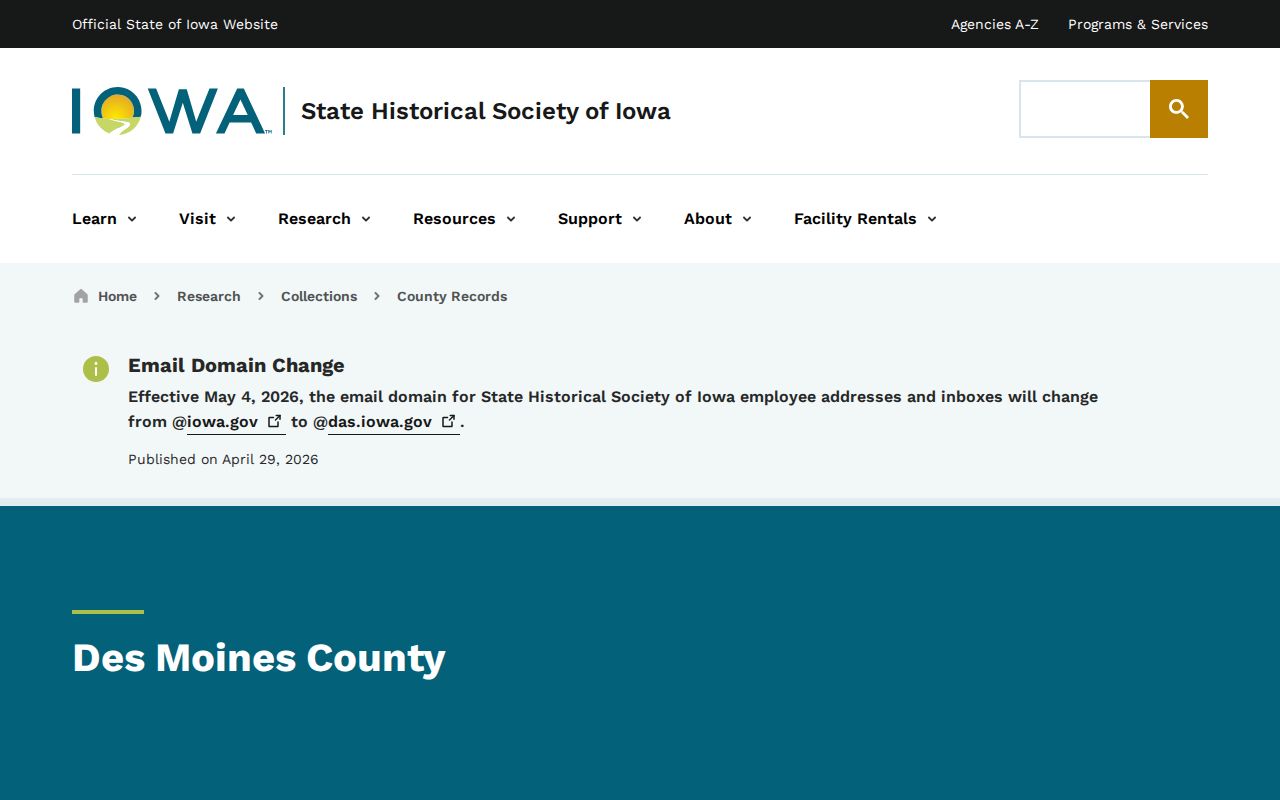
Use its series dates to choose a reel, then ask the Recorder, Clerk, library, or historical society about the missing interval.
Use Burlington Past Households Lawfully
A clear Burlington previous residents file keeps ownership, occupancy, subscription, and family evidence separate. A deed shows a recorded transfer. A directory shows a dated listing. A census describes a household on its census date. An obituary is a published notice. Together they can answer who lived here before, but none should be stretched beyond what it records.
Save the source title, year, page or instrument number, original address, and access date. For fragile or one-of-a-kind library material, in-person use may be required; microfilm is preferred where available. The Des Moines County Recorder at 513 N Main Street also takes counter, mail, phone, and email inquiries for land records.
Lawful use. Research past residents for house history, genealogy, or estate work, and never use an address trail to watch, harass, or harm a living person.