
Burlington City Directory Shelf
The Burlington Public Library tracing guide gives the strongest local chronology. It distinguishes the early business-only book, the long microfiche run, recent help-desk access, reverse directories, and phone directories. FamilySearch adds reel-level catalog detail. The Library of Congress supplies readable online telephone books, but those are commercial subscriber publications rather than ordinary city volumes.
| Collection | Years | Where Held | Access |
|---|---|---|---|
| Early Burlington volumes | 1856 business-only; 1859; 1862; 1866 | Burlington Public Library and FamilySearch catalog | Microfilm, catalog, or Library help |
| Historical directory run | 1868–1995 | Burlington Public Library | Microfiche; ask staff for exact year |
| Recent directories | 1996–present | Burlington Public Library | Help-desk request |
| Reverse directories | From 1889 | Library city-directory run | Search address to listed name |
| Telephone directories | 1934–present; online 1948–1951 and 1957–1960 samples | Library and Library of Congress | In person or free online scan |
No precise last printed year or readable ordinary Burlington entry was exposed in unattended research. The supported statement is that post-1995 material is available through the help desk. A missing year can mean a publication gap, holding gap, scan restriction, or failed name search, so ask about the exact volume before inferring absence.
Burlington Library Directory Access
The Library's genealogy and local-history collection is at 210 Court St. Hours are Monday through Thursday, 9 a.m. to 8 p.m., and Friday through Saturday, 9 a.m. to 5 p.m. Call 319-753-1647 before a visit to confirm a reel, volume, reader, or fragile item. The collection policy says one-of-a-kind materials may be in-library only and microfilm is preferred when available.
Remote sources include historic Iowa newspapers, local histories, census and pension material, PERSI, Heritage Hub obituaries, Chronicling America, and Hawk Eye databases. In-library tools add court, land, probate, vital, church, directory, passenger-list, and military resources. That mix makes the Library more useful than one shelf alone because a dated entry can be tested against a second source without changing repositories.
Note: Ask for the publication year, format, reel or volume, page, copy method, and any limits before traveling.
Burlington Directories on FamilySearch
FamilySearch catalog 243005 describes ten reels of Burlington city-directory microfilm made in 1975 through 1978. Access to images can require an account, a participating library, or a FamilySearch center. A catalog row proves that the reel was described, not that every image is open from home.
The reel data is precise enough to plan a search. Film 956377 covers the early 1856, 1859, 1862, 1866, and 1868–1870 group. Film 956378 covers 1871–1878, and 956379 covers 1878–1882. Other films include 1881–1886, 1884–1888, 1892–1894, and repeat or mixed-year items. Record the film, item, and digital group number alongside the page citation because the same year can appear on more than one reel.
Burlington Historical Phone Sample
The Library of Congress Burlington telephone directory spans January 1948 through December 1951 and offers OCR, images, and PDF access. A second scan covers May 1957 through April 1960. These books can include Burlington and West Burlington markers, so place labels must be read rather than assumed.
A residential page can show surname, given name or initial, a Mrs honorific, an r residence marker, street number and name, city marker, telephone exchange, and number. It does not show date of birth, age, parcel ID, occupancy dates, or legal title. Cite it as a telephone subscriber listing with publication span and page, never as a government resident roll.
Burlington's 1948–1951 phone book is an unusually clear digital sample, but the attempted page screenshot failed in the manifest. The source remains useful as text and scanned evidence without substituting an unrelated image.
Read a Burlington Directory Entry
Read only the fields printed in the specific Burlington volume. Later habits cannot be projected onto an early book. The accessible phone sample verifies a small field set, while an ordinary city volume may add spouse, trade, business, or home marks only if its own key defines them. Photograph or copy the title page and abbreviation key before extracting entries.
| Name | Surname, given name, initials, honorific, or the exact printed form |
|---|---|
| Household clue | Spouse, widow, or householder wording only when the volume supplies it |
| Work or trade | Occupation or business link if printed and defined by the key |
| Address | House number and street, preserved as printed for that year |
| Source marks | Residence, owner, renter, boarder, or phone marks only as that key defines them |
- Criss-cross directory
- A later street-order section that starts with an address and points to a listed name.
- Householder index
- An index centered on the person identified by the publisher as the household listing.
- Abbreviation key
- The volume's own legend for short forms and symbols, which should control every transcription.
An entry proves that a publisher associated the printed name and address at that edition date. It does not prove continuous presence, title, or the identity of every person at the address.
Burlington Directory Numbers Changed
The Library states that Burlington street numbering changed in 1938. Reverse directories had begun in 1889, which creates a useful overlap, but an old number should never be silently replaced with a modern one. Keep the old address in the transcription and place any modern match in a separate sourced note.
Use a period directory with Sanborn maps from 1886, 1892, 1900, or 1931 and additions through 1950. The 1873 illustrated atlas, plat books, county GIS historic layers, and city permit or preservation files can add a second bridge. This address shift is one of Burlington's clearest local reasons to search by both surname and street.
Burlington Directory Record Timeline
The historical shelf sits inside a longer local records story. Burlington was the county seat and Iowa Territorial capital in 1838. County history reports that an 1873 Mozart Hall courthouse fire destroyed some records. The Library's overlapping publications, papers, maps, and later microfilm can therefore supply leads when an early government series has a gap.
| Year | Directory or record milestone |
|---|---|
| 1856 | Business-only Burlington directory documented |
| 1868 | Start of the long Library microfiche run |
| 1889 | Reverse-by-address directories begin |
| 1934 | Phone-directory holdings begin |
| 1938 | Burlington street numbering changes |
| 1996 | Later directories become a help-desk request run |
The first book was not a full household roll, and the last printed year remains unverified. Those limits belong beside the dates rather than being smoothed into a complete run.
Burlington Directory Companion Sources
A directory gap is best tested with a source from the same time. The Library lists Hawk Eye coverage from September 30, 1843 to the present, several nineteenth-century newspaper runs, an obituary card file from 1976 forward, and older obituary clippings and reels. Its Local History and Genealogy Request Form charges $5 per record, needs a complete date, and currently allows staff to search up to seven days on either side.
School sources include Burlington High School graduate records and Pathfinder yearbooks, Notre Dame selections, Blackhawk Burlington Junior College, and Southeastern Community College runs. Cemetery permits, funeral-home books, probate indexes, naturalization reels, and land records can also explain why a name appears, changes form, or drops out. Preserve initials, Mrs forms, spouse notation, and spelling exactly to avoid joining two Burlington residents with the same name.
Note: A directory absence may be a spelling, edition, holding, or digitization gap rather than proof that someone left Burlington.
Burlington City Records Add Context
The Burlington City Clerk keeps municipal code, proceedings, ordinances, resolutions, licenses, permits, notices, agreements, leases, and liens. When a directory entry points to a building or civic activity, the city open-records form can request a named record type and date range. The form asks for a description, requester details, contact information, signature, delivery choice, and CAPTCHA.
The manifest image shows that official Burlington request route.
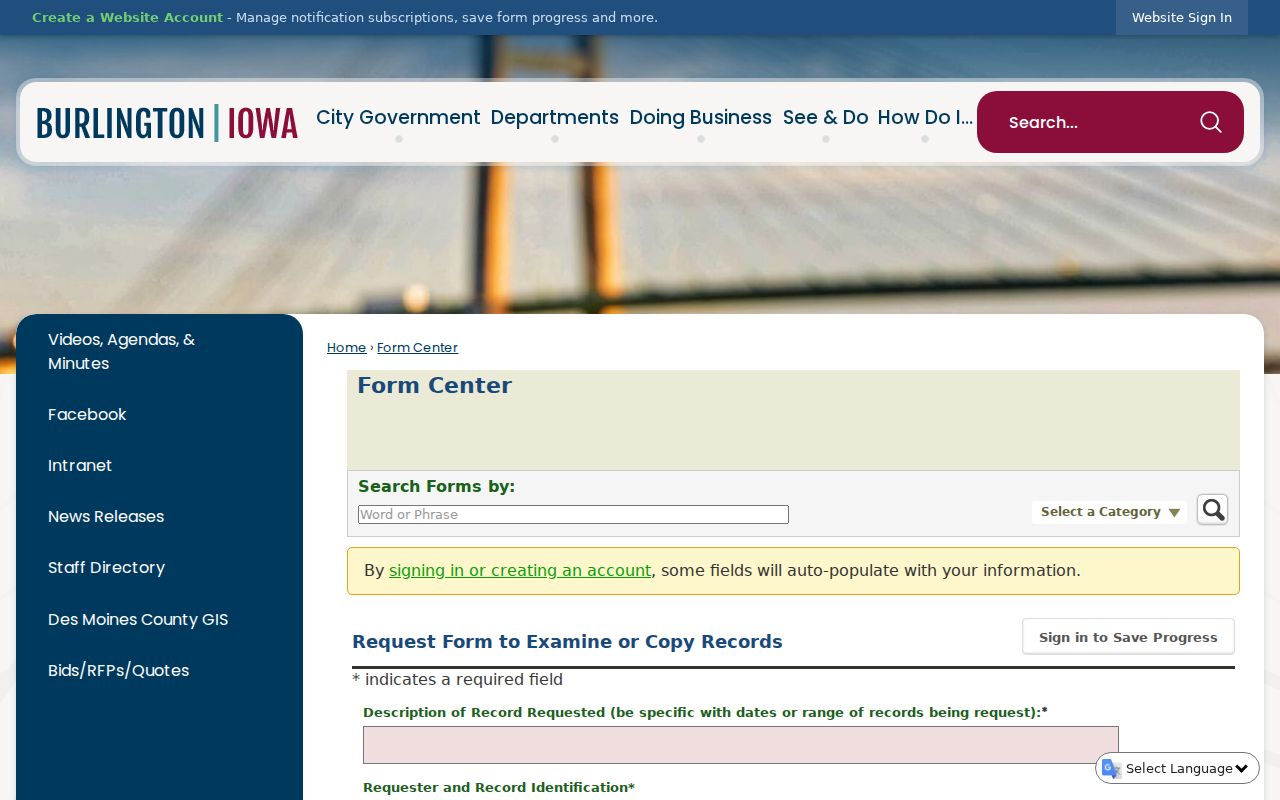
The city generally targets a response within 14 working days, subject to exemptions, volume, and complexity. Ask for a permit holder, applicant, named party, or dated item rather than asking the clerk to identify a resident from a directory.
Burlington History Beyond Directories
The Des Moines County Historical Society's Heritage Center preserves local archive and museum layers, while the State Historical Society of Iowa catalogs government series. Downtown Partners adds a civic path for downtown preservation and district activity. These bodies do not replace the Library shelf, but they can hold a photograph, artifact, event record, or local file that explains a directory address.
The manifest's Downtown Partners entry shows one Burlington civic contact point.

Use the exact organization, item, date, and access terms. No full public membership roll or item-level finding aid was located, so a narrow question is more reliable than a broad name request.
Trace Family in Burlington Directories
Follow a household across dated editions, then pair the entries with census, newspaper, and death sources. The Library lists federal census material from 1840 through 1930 and Iowa census years including 1836, 1852, 1854, 1856, 1885, 1895, and 1925. A census and a dated publication answer different questions, which makes their agreement useful.
- Search the nearest known year with every surname, initial, and honorific form.
- Move one edition at a time. Record each address, mark, trade, spouse form, and page.
- Check the reverse section from 1889 onward to see what the publisher listed at the address.
- Pair an entry with the nearest released federal or Iowa census and cite both dates.
- Test the last listing against a newspaper, obituary, cemetery, probate, or later phone book.
A disappearance may mean a move, death, unlisted phone, changed surname, missed spelling, or absent volume. Do not choose among those outcomes without a second record. Modern address-keyed work belongs in the Burlington street directory, where parcel and deed roles can be checked without rewriting the historical shelf.